
Your savings account shouldn't be a waiting room for "maybe." Most people treat their bank account like a black hole. Money goes in. It sits. It stalls. It loses value. You're likely tired of the spreadsheet fatigue. You feel that vague anxiety because your cash is idling in a low-interest account while the world moves on. It's time to stop mindless saving and embrace goal based financial planning.
You want a house. You want to travel. You want a retirement that doesn't feel like a gamble. We get it. Traditional investing is too complex and sucks up too much time. This guide shows you how to build a strategic roadmap that hits your milestones on autopilot. You'll learn to use AI to handle the math while you keep total control. We will break down the 2026 tax landscape, including the $24,500 401(k) contribution limit, and show you how to give every dollar a job. It's your future. Let's put it on a flight plan that actually lands.
Key Takeaways
- Stop hoarding cash without a plan. Learn to pivot from mindless saving to a strategy where every dollar fuels a specific future milestone.
- End the tug-of-war between today's bills and tomorrow's dreams. Discover why a hybrid approach is the only way to fund your life and your wealth simultaneously.
- Master a four-step framework to audit your assets and set hard deadlines for big wins like a new home or early retirement.
- Put your goal based financial planning on autopilot. See how permission-first AI handles the heavy lifting while you stay in the driver's seat.
Rethinking Your Money: What is Goal-Based Financial Planning?
Most people save for nothing in particular. They call it "emergency funds" or "retirement," but it is often just a pile of cash without a clear purpose. Goal based financial planning flips the script. It is a strategy where every financial decision serves a specific future win. Instead of a vague financial plan, you build a roadmap of concrete milestones. It is the difference between wandering and driving with a GPS. Goal based financial planning is the only way to ensure your wealth grows with intention.
Traditional budgeting feels like a diet. It is all about what you cannot spend. Goal-based planning is about what you can achieve. You stop focusing on deprivation and start focusing on aspiration. By 2026, AI has turned this from a luxury for the ultra-wealthy into a tool for everyone. It is the engine that runs the math so you do not have to. It makes the complex simple.
The End of the "Save and Hope" Era
Traditional savings accounts are where dreams go to stall. If your money is just sitting there, inflation is eating it alive. Vague habits carry a heavy opportunity cost. You are not just saving; you are losing time. "Save and hope" is not a strategy. It is a risk. In 2026, the tax landscape is complex. With the 401(k) contribution limit at $24,500, every dollar needs a destination. You need movement, not just storage.
Why Milestones Matter More Than Balances
A milestone is a time-bound, cost-specific life event. It is not "someday I will buy a house." It is "$80,000 for a down payment by June 2028." Viewing money through the lens of goals reduces financial anxiety. You stop obsessing over a single, scary number. Instead, you track progress on things that actually matter:
- The house you will buy in three years.
- The sabbatical you will take in five.
- The retirement that starts on your terms.
Goals vs. Cash Flow: Why You Need a Hybrid Approach
Cash flow is about the "now." It's your bills, rent, and groceries. Goals are about the "next." That is your wealth, freedom, and legacy. Most people treat these as enemies. They think they must suffer today to have a future. Or they spend today and ignore tomorrow. This is a false dilemma created by outdated tools. You don't have to choose. You can have both.
Modern goal based financial planning bridges this gap. It turns your daily spending into a launchpad for your long-term ambitions. By integrating your bank accounts with a smart system, you see how every transaction affects your 2030 timeline. It's about making your money work as hard as you do.
The Cash Flow Trap
Focusing only on monthly expenses prevents wealth accumulation. The traditional "S=I-T-E" model (Savings = Income - Taxes - Expenses) is reactive. It treats savings as a leftover. If there's nothing left at the end of the month, nothing is saved. This trap leaves your money idle in low-interest accounts while you wonder what is financial planning actually for. It's a post-mortem on your money. You need a flight plan, not a receipt pile.
The Goal-Based Solution
AI provides the edge. It doesn't just track; it acts. Smart systems identify excess cash flow before you can spend it. It "sweeps" those funds into goal-specific buckets automatically. You maintain liquidity for your life today while pursuing aggressive growth for tomorrow. This creates a personalized financial roadmap that adjusts in real-time. No more manual transfers. No more guessing. Just execution. This is goal based financial planning built for the modern world. You can automate your strategy today without losing a second of control.
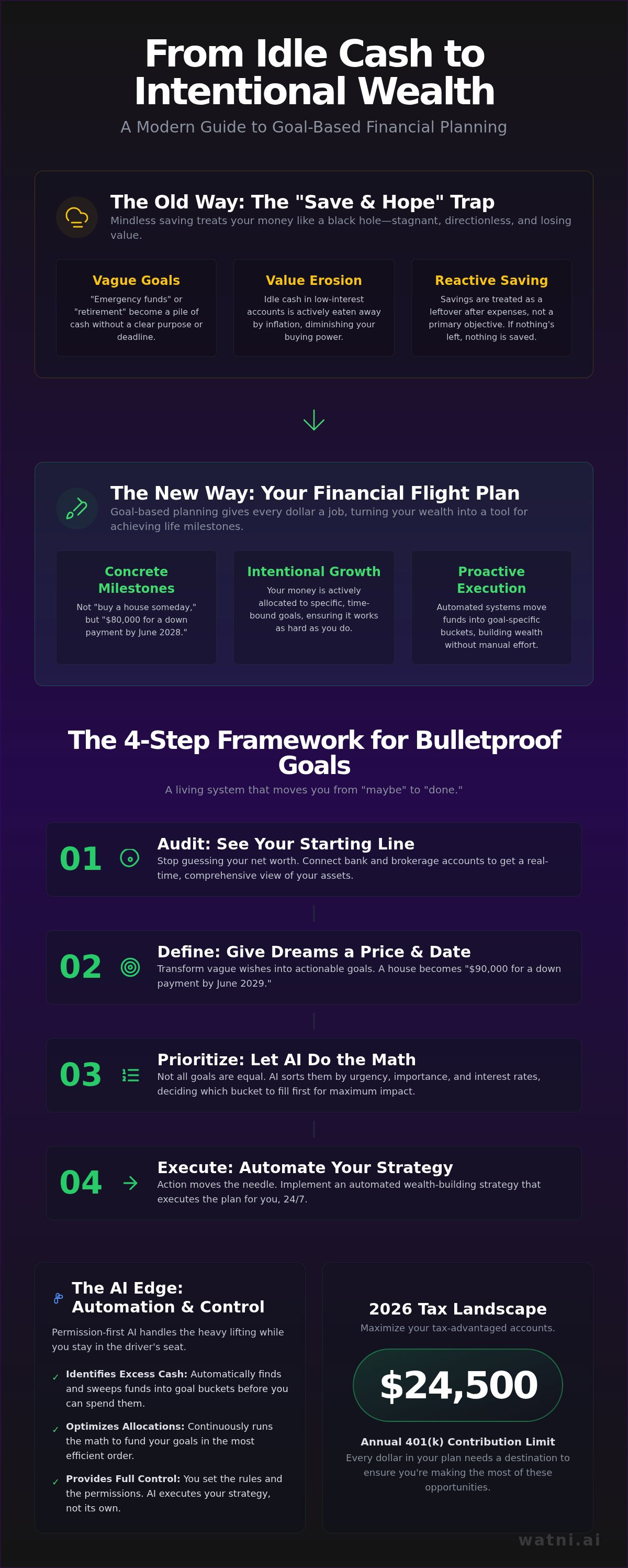
The 4-Step Framework for Bulletproof Financial Goals
Planning is useless without a process. Most traditional plans are just static PDFs gathering dust. They're dead on arrival. You need a living system that moves you from "maybe" to "done." This 4-step framework is your roadmap to goal-based financial planning. It's designed to handle the complexity of 2026 while you focus on living.
- Step 1: Audit. Stop guessing your net worth. Connect your bank and brokerage accounts to see the real starting line. No more manual entry.
- Step 2: Define. Give every dream a price tag and a date. A house isn't just a wish; it's $90,000 by June 2029.
- Step 3: Prioritize. Not every goal is equal. AI sorts them by urgency and interest rates. It handles the math of which bucket gets filled first.
- Step 4: Execute. Shift to an automated wealth building strategy. Action is the only thing that moves the needle.
Turning Dreams into Data
"Retirement" is too vague. You need a hard number. In 2026, the 401(k) employee contribution limit is $24,500. Are you hitting it? Your plan must account for these caps and inflation-adjusted math. AI calculates the future cost of today's dreams. It turns a vague hope into a precise data point. Every dollar gets a specific destination. You stop saving for "nothing" and start funding your life.
Dynamic Re-prioritization
Life isn't linear. You might change jobs or start a family. A static plan fails the moment reality hits. You need "live" data from your bank accounts. Goal based financial planning must pivot as fast as your life does. If your income shifts, your roadmap should recalculate instantly. This keeps you moving forward without the spreadsheet fatigue. Build your roadmap now and stay in control of every move.
Automation Without Losing Control: The AI Edge
Automation isn't a hand-off. It's a power-up. Most people avoid automated tools because they fear losing the wheel. That's a valid concern. You worked hard for your money; you should decide where it goes. In 2026, the best systems use a "Permission-First" architecture. The machine handles the math. You give the thumbs up. This is how goal based financial planning actually scales without the stress.
Watni acts as your ai powered personal finance assistant to manage the heavy lifting. It connects to your accounts and spots opportunities you might miss. Maybe it's a higher-yield bucket or a tax-advantaged 401(k) move. It prepares the transfer. You get a notification. You approve. It's done. Total transparency. Zero friction.
Safe Automation in 2026
AI identifies the best accounts to fund on your behalf. It weighs interest rates against your specific deadlines. But it doesn't go rogue. Every suggested move lands in your "Approval Queue." You stay in the driver's seat while the AI handles the navigation. It's like having a co-pilot who never sleeps and never misses a decimal point. You get the efficiency of a machine with the final say of a human.
Your First Automated Milestone
Don't wait for the "perfect" plan to start. Build your automation muscle now. Start with a small, visceral goal like a travel fund or a new tech budget. Seeing those first few dollars move automatically builds confidence. The compound effect of starting today is massive. Goal based financial planning is about momentum, not just math. Start small. Scale fast. Win often. It's your future. Put it on a flight plan that actually moves.
Take Command of Your 2030 Today
Stop letting your money idle in the waiting room of "someday." You've seen the difference between mindless saving and a precise flight plan. You know how to audit your starting line and define milestones with hard dates. Goal based financial planning turns stagnant cash into active wealth by giving every dollar a specific job. The tech has finally caught up to your ambition. You don't need a manual spreadsheet; you need a system that executes while you live.
It's time to stop stalling. Watni provides no-nonsense AI guidance through direct bank and brokerage integration. You get the speed of automation with a permission-first architecture that keeps you in charge of every move. Every dream needs a dollar amount and a deadline. Build your personalized financial roadmap with Watni AI. Your future isn't a guess. Let's make it a certainty.
Frequently Asked Questions
Is goal-based planning better than traditional budgeting?
Yes, it is more effective because it focuses on outcomes rather than restrictions. Traditional budgeting is a post-mortem on what you've already spent. Goal based financial planning is a roadmap for where you're going. It replaces the feeling of deprivation with the excitement of funding a specific dream. You aren't just cutting back; you're actively building toward a house or a 2026 travel milestone.
How does AI help with financial goals in 2026?
AI serves as the engine that handles the complex math. In 2026, it connects your bank and brokerage accounts to find idle cash instantly. It calculates inflation-adjusted targets and helps you hit contribution limits, like the $24,500 cap for 401(k)s. Instead of a dead PDF, you get a living strategy that pivots as your life changes. It handles the navigation while you keep the final say on every move.
Do I need a lot of money to start goal-based planning?
No, you can start with any income level. This strategy isn't a luxury for the 1%. It's a tool for anyone who wants their money to have a purpose. Starting with a small goal, like a $500 emergency fund, builds the "automation muscle." The logic remains the same whether you're saving for a laptop or a retirement home. Every dollar needs a job. Start where you are today.
Is it safe to let an AI manage my financial plan?
Safety is built into goal based financial planning architecture. A permission-first system means the AI identifies opportunities but never executes without your thumbs up. You stay in the driver's seat. Every suggested transfer lands in an approval queue for you to review. Direct brokerage integration ensures your assets remain in secure, regulated accounts. You get the efficiency of modern technology with the peace of mind of total manual control.
How many financial goals should I have at once?
Aim for three to five active milestones to keep your progress visible. Having too many goals can spread your cash flow too thin and stall your momentum. A balanced roadmap usually includes a mix of short-term wins and long-term wealth targets. AI helps you prioritize these by analyzing interest rates and deadlines. It ensures you fund your most urgent needs without neglecting your 2030 ambitions.


