
What if your bank account actually did the work instead of just sitting there? Most people spend hours staring at spreadsheets or freezing when it's time to pick an index fund. It's exhausting. You're tired of high fees and the fear of making a manual entry error that costs you thousands. You want an app that opens investment accounts for you and handles the heavy lifting while you sleep. It sounds like science fiction, but by August 2026, it's becoming the standard for the 49% of global consumers already using AI for their money.
You've heard the myths. People say AI is a "black box" or that it's too risky to let an algorithm touch your savings. They're wrong. You're about to learn how a modern AI personal finance assistant safely automates your wealth and opens accounts without you lifting a finger. We're debunking the five most dangerous myths holding you back. We'll explore the 2026 reality of permission-based execution, total security, and the end of analysis paralysis. It's time to trade your spreadsheets for a personalized financial roadmap.
Key Takeaways
- Stop treating AI like a search bar. It's a digital architect that builds a real strategy for your net worth.
- Find an app that opens investment accounts for you to kill the manual spreadsheets and automate your wealth building.
- Trust the tech through a permission-first model. Nothing moves unless you say "Yes" first.
- Ditch the high fees and slow manual processes for a roadmap that processes thousands of data points in seconds.
Beyond the Hype: What an AI Personal Finance Assistant Actually Is
Most people think AI is just a fancy search bar. It isn't. An AI personal finance assistant is a software layer that lives between your goals and your bank accounts. It doesn't just talk; it acts. In 2026, these systems are digital architects for your net worth. They integrate directly with your bank and brokerage accounts to turn "knowing what to do" into "getting it done." It's the difference between reading a map and having a self-driving car.
Advice vs. Execution
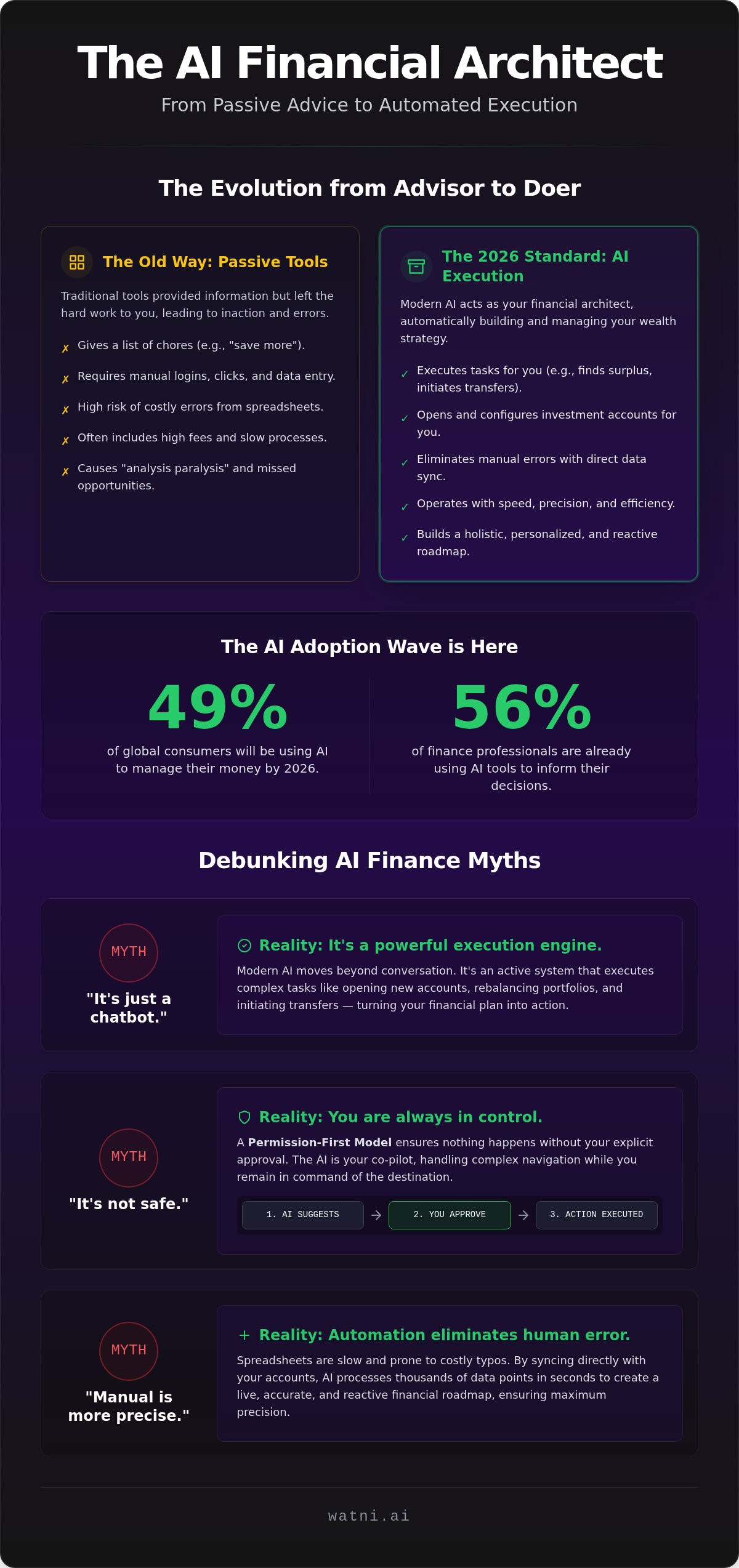
Old tools were passive. They gave you a list of chores. You had to log in, click buttons, and hope you didn't mess up. Intelligent financial automation has changed the game. It doesn't just suggest you save $500; it finds the surplus and initiates the transfer. This is the natural evolution of Robo-advisors. We've moved from simple algorithms to active execution engines that handle the heavy lifting while you focus on living your life.
The Digital Architect
Wealth isn't just one account. It's a complex web of debt, savings, and investments. A modern assistant acts as a digital architect. It builds a personalized financial roadmap based on your real-time data. It looks at the big picture. If you need a new brokerage account to optimize your taxes, you don't need to fill out forms for three hours. You use an app that opens investment accounts for you. It handles the paperwork. It sets up the plumbing. You just give the green light. By focusing on your holistic net worth, the assistant ensures every dollar has a job. It's about speed, precision, and taking the burden off your shoulders. No more spreadsheets. No more guesswork. Just results. In a world where 56% of finance professionals are already using these tools, it's time you had that same power in your pocket.
The Chatbot Myth: Why Modern AI is an Execution Engine
The biggest myth in 2026 is that AI is just a chatbot. If you're asking a bot for budgeting tips, you're stuck in 2023. A true ai powered financial assistant is an execution engine. It doesn't just tell you to "invest more." It opens the account and rebalances the portfolio for you. It's about moving from talking to doing. Automation handles the friction. It fills the forms. It checks the boxes. You just provide the permission. This isn't just about convenience; it's about accuracy. AI doesn't get tired or bored.
The App That Opens Investment Accounts For You
Choosing between a Roth IRA and a taxable brokerage account used to take hours of research. Now, AI identifies the best account type for your specific goal in seconds. This is the shift to AI-facilitated creation. You don't lead the process; you approve it. An app that opens investment accounts for you handles the boring paperwork while you stay in control. This level of transparency is backed by federal guidance on AI in lending, which ensures these systems remain explainable and fair. You get the speed of a machine with the oversight of a human.
The Death of the Manual Spreadsheet
Manual tracking is where wealth goes to die. It's slow. It's prone to errors. One typo in a cell can ruin a year of planning. AI eliminates this by syncing directly with your accounts. It creates a live, reacting wealth roadmap that updates as you spend and earn. Nearly 49% of global consumers have already used AI to support their investment decisions. They aren't typing into Excel; they're letting the tech handle the data entry. If you want to stop guessing and start growing, it's time to automate your wealth architecture. Automation isn't just a luxury. It's the only way to keep up with a fast-moving market.
The Safety Myth: How Permission-First AI Keeps You in Control
You're worried about a machine going rogue with your life savings. It's a common fear. But the idea that AI moves money behind your back is a total myth. Modern wealth tech uses a Permission-First model. Nothing happens without your explicit "Yes." It's a co-pilot, not an autopilot. You hold the keys. You set the destination. The AI just handles the flight path. It's about empowerment, not replacement. You stay in the driver's seat while the machine does the navigation.
Security is the bedrock of this system. By using read-only access for initial analysis, you gain the benefits of linking all financial accounts without handing over the vault keys. You see the whole board. The AI spots the gaps. It finds the hidden fees and the missed opportunities. But it can't cross the finish line without your direct approval. This is how you scale your wealth without losing your sleep.
The Permission Layer Explained
Every move requires a nod. If the system finds a better interest rate or a smarter tax play, it pings you. Watni sends a notification for every proposed transfer or account change. Explicit approval is the non-negotiable standard for 2026. This is how an app that opens investment accounts for you stays transparent. You're never surprised by a transaction. You're simply briefed on the best path forward and asked for the green light. It's total control with zero effort.
Encryption and Security Standards
Your physical wallet is a liability. It can be dropped, lost, or stolen. Modern AI assistants are far more secure. They use 256-bit encryption to scramble your data. This is the same level of protection used by global banks. Your information remains private and protected from prying eyes. If you're ready to build wealth with total peace of mind, secure your financial future today. The tech is built to protect you first and grow you second. It's time to trust the math and the encryption.
The Human-Only Myth: Why AI is Often More Precise
You've been told a "real" financial plan needs a human touch. That's a legacy belief. In reality, a human takes weeks to build what an AI does in seconds. Humans have biases. They get tired. They often ignore clients with smaller balances. AI doesn't. It processes thousands of data points without blinking. It treats every dollar with the same level of precision. While 72% of consumers still want human involvement, the data shows that machines are simply faster and more objective. Even 56% of finance professionals are now using AI in their own work. They know the machine is more precise.
Cost vs. Performance
Traditional advisors eat your returns with high fees. AI costs less than your monthly streaming bill. This isn't just about saving money; it's about access. Fiduciary-grade logic used to be for the 1%. Now, an app that opens investment accounts for you brings that same power to everyone. You get high-performance architecture without the high-end price tag. It's a rebellion against the old guard. You deserve elite strategy regardless of your starting balance.
Real-Time Adaptation
Markets don't wait for your advisor to finish their coffee. They move in milliseconds. AI reacts to market shifts instantly. While an advisor is still asleep or stuck in a meeting, your AI assistant is already adjusting your roadmap. Your plan evolves every time you spend a single dollar. It's a living strategy. This level of hyper-personalization was impossible five years ago. Now, it's the standard for anyone serious about building wealth. It stays contextually aware of your life and the economy 24/7. You get a plan that grows as fast as the world moves.
Own Your Wealth Architecture
The wealth building game has changed. You've seen how the myths of the past are crumbling under the weight of 2026 tech. AI isn't just a chatbot giving vague advice. It's an execution engine that replaces manual spreadsheets with real-time precision. You get the benefit of a digital architect that works 24/7 without the high fees of a human advisor. Security isn't a concern when you use a permission-first model. Nothing moves without your explicit "Yes."
It's time to stop the analysis paralysis. You need an app that opens investment accounts for you so you can quit the boring paperwork and start seeing results. Real-time bank integration and zero manual data entry mean your roadmap is always current. You stay in total control. The technology handles the heavy lifting. Stop guessing. Build your permission-first wealth roadmap with Watni. Your future self will thank you for making the switch today. You're ready for this.
Frequently Asked Questions
Is an AI personal finance assistant safe to use with my bank?
Yes, it's safer than your physical wallet. Modern assistants use 256-bit encryption and read-only access to analyze your data. They must follow strict rules like the amended Regulation S-P, which has a June 3, 2026, compliance deadline for securing customer info. Your bank credentials aren't stored; they're used to build a bridge. You get the insights without giving up the keys to the vault. It's about radical transparency and military-grade security.
Can an app that opens investment accounts for you move money without permission?
Absolutely not. A legitimate app that opens investment accounts for you operates on a permission-first model. Every transfer, account opening, or portfolio rebalance requires your explicit approval via a notification. You're the pilot; the AI is the navigator. It spots the best route, but it won't turn the wheel until you say so. This ensures you maintain total control while the technology handles the boring, manual paperwork.
How does an AI financial assistant differ from a budgeting app?
Budgeting apps are passive mirrors that show where your money went. They rely on manual entry or simple categorization. An AI financial assistant is an active digital architect. It doesn't just track your spending; it executes your wealth strategy. It identifies surpluses and moves them into high-yield accounts or investments. While a budgeting app tells you that you spent too much on coffee, an AI assistant actually builds your net worth.
Do I still need a human financial advisor if I use AI?
Not for the technical execution. AI processes thousands of data points in seconds, something no human can match. However, 72% of consumers still want a human involved for high-stakes emotional decisions. Think of AI as your high-performance engine and a human as an occasional consultant for life's big shocks. For daily growth and precision, the machine wins. It doesn't get tired, biased, or bored with your small-balance accounts.
What happens if the AI makes a mistake in my financial plan?
The system is designed with multiple fail-safes. Because it's a permission-based engine, you review every proposed move before it happens. If the market shifts or your goals change, the AI reacts instantly to update your roadmap. It uses real-time data to correct course, unlike a human plan that sits in a drawer for a year. You are the final filter, ensuring every action aligns with your personal financial roadmap.


