
Your bank account shouldn't feel like a second job. For years, we've been told that managing wealth means drowning in spreadsheets and juggling a dozen apps that don't talk to each other. It's exhausting. You're likely tired of the manual data entry and the constant fear that an automated bot might make a mistake with your hard-earned cash. We get it. The old way of tracking every penny is dead. In 2026, an ai powered financial assistant isn't just a chatbot that gives generic advice. It's an execution engine that handles the heavy lifting while you stay in the driver's seat.
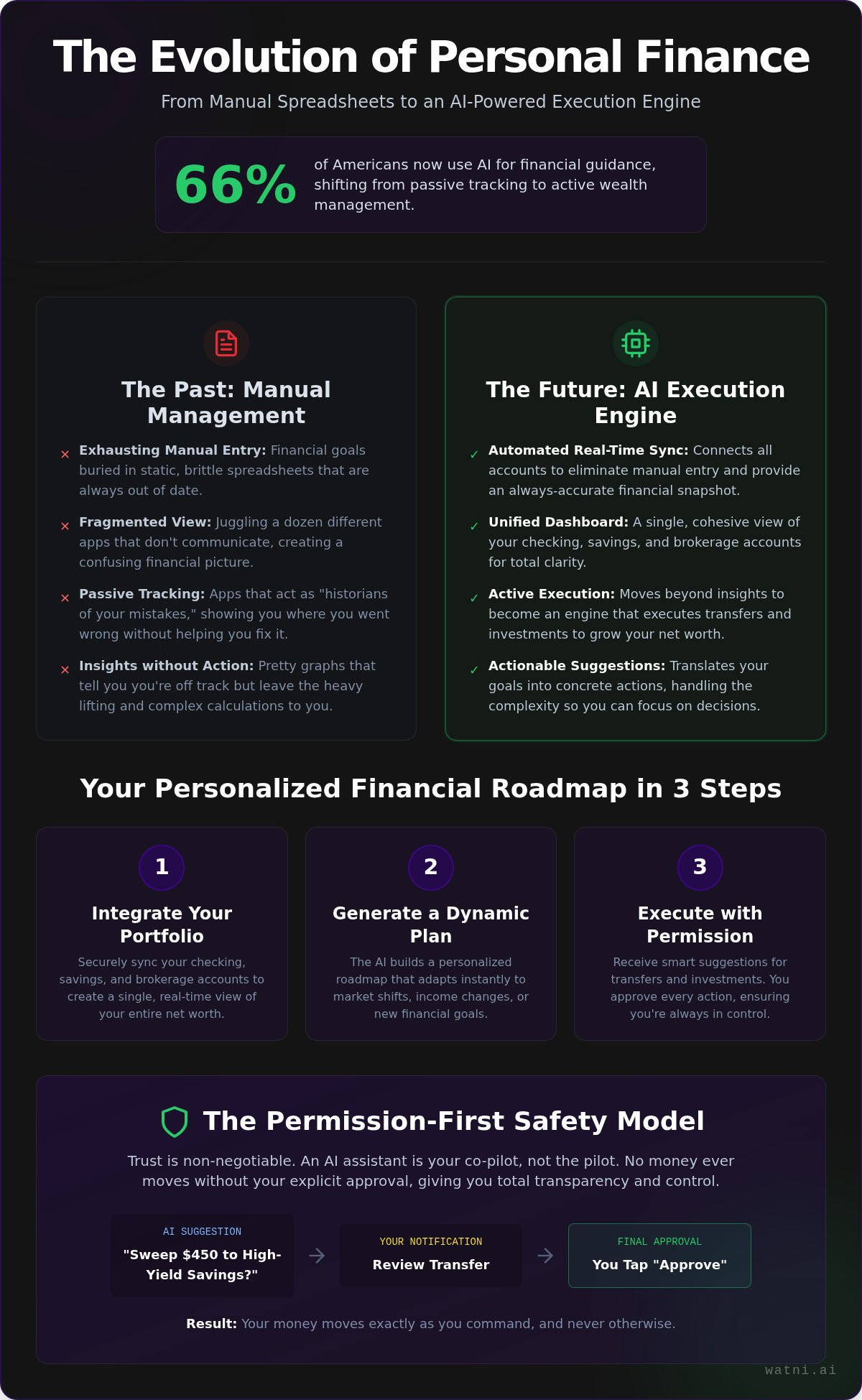
We agree that you deserve total transparency without the manual labor. With over 66% of Americans now using AI for financial guidance, the technology has finally caught up to our needs. This guide shows you how to turn your finances into a wealth autopilot that builds personalized roadmaps and moves money only with your explicit approval. You'll discover how to integrate your entire portfolio into one real-time dashboard and automate your savings with total precision. It's time to stop managing your money and start growing it.
Key Takeaways
- Move from passive tracking to active execution with a modern ai powered financial assistant that does the heavy lifting for you.
- Sync your bank and brokerage accounts to generate a personalized financial roadmap that reflects your real-time net worth.
- Secure your assets with the "Permission-First" safety model, ensuring no transaction happens without your direct approval.
- Learn how to spot a true execution engine by focusing on multi-account integration rather than just pretty graphs.
What is an AI Powered Financial Assistant in 2026?
Budgeting apps failed because they gave you homework. They asked you to categorize every transaction while offering zero help in growing your net worth. They were historians of your mistakes, not architects of your future. In 2026, an ai powered financial assistant is a high-performance engine. It doesn't just watch your money; it moves it. This isn't about pretty charts that tell you that you spent too much on coffee. It's a software layer that integrates with your bank and brokerage accounts to actually manage your wealth.
Modern Financial technology (FinTech) has finally shifted from passive tracking to active execution. The core components are simple: real-time planning, deep account integration, and permission-based movement. It's about taking the burden of complexity off your shoulders and putting it onto the technology. It's about results, not just observations.
The Death of the Manual Spreadsheet
Manual entry is the graveyard of financial goals. It's the number one reason people quit planning their future. Spreadsheets are static, brittle, and exhausting. An ai powered financial assistant eliminates the need for set and forget models that break the moment life happens. It stays dynamic. It sees a change in your income or a shift in market trends and adjusts your plan instantly. You don't have to spend your Sunday afternoon updating cells. The AI handles the data so you can focus on the decisions.
From Insights to Actions
There is a massive gap between seeing data and doing something about it. Most apps stop at the insight stage. They tell you that you're off track but leave the fix to you. A true execution engine crosses the finish line. It uses generative AI to translate your goals into actual transfers. Whether it's topping up an investment account or sweeping extra cash into savings, it creates a personalized financial roadmap that executes with your permission. You stay in control. The AI handles the heavy lifting.
How AI Financial Planning Builds Your Roadmap
A map is useless if it doesn't know where you are. Most financial plans are outdated the moment they're printed. An ai powered financial assistant changes that by syncing your entire life in real-time. It connects your checking, savings, and brokerage accounts into one cohesive view. This isn't just about seeing numbers. It's about building a personalized financial roadmap that actually moves as you do.
The Integration Engine
Secure APIs are the backbone of this system. They pull data from every corner of your portfolio without compromising your security. This creates a holistic financial planning app experience that goes beyond simple dashboards. While the U.S. Treasury emphasizes the need for a robust AI risk management framework, your ai powered financial assistant uses these standards to ensure your data stays private while your wealth stays connected.
Goal-Based Execution
Stop guessing how much you need to save. Whether it's an emergency fund or a retirement milestone, the AI does the heavy lifting. It identifies exactly how much to sweep into investments to hit your goal based financial planning targets. If your income drops or a bonus hits, the assistant reacts. It scales your contributions up or down instantly. It's math without the migraine.
No more spreadsheets. No more "I'll do it tomorrow." The roadmap updates itself, so you're always on the fastest path to your goals. If you're tired of manual tracking, you can start your automated journey and let the technology handle the details.
The Permission-First Model: Why Safety is Non-Negotiable
Trust is earned, not given. People worry that an ai powered financial assistant will drain their accounts while they sleep. That's a valid fear. It's also a myth. In 2026, the technology isn't designed to act as a rogue agent. It follows the Permission-First rule. No money moves without your explicit approval. You see the destination. You see the amount. You hit the button. It's total transparency at every step.
User Sovereignty in Automation
Full automation without human oversight is a recipe for anxiety. You're always the pilot. The AI acts as your high-speed co-pilot. Every suggested transfer arrives as a simple notification on your phone. "Should we sweep $450 to your high-yield savings today?" You have the final say. This is the core of intelligent financial automation. It's about removing the friction of manual transfers while keeping you firmly in the driver's seat.
Security Architecture in 2026
Security standards have evolved to meet the demands of modern wealth management. We use industry-leading protocols to ensure your peace of mind:
- 256-bit encryption for all data at rest and in transit.
- Mandatory 2FA to prevent unauthorized access.
- Zero-data selling to protect your privacy from third parties.
Some platforms treat your data like a product, selling your habits to the highest bidder. We don't. Your ai powered financial assistant remains encrypted, private, and entirely under your control. Radical simplicity doesn't mean cutting corners on safety. We focus on movement and results, not data harvesting. Your financial life remains private, secure, and built for growth.
Stop worrying about "what if" and start focusing on "what's next." Experience secure wealth automation now and see how precision meets protection.
Choosing Your AI Assistant: What to Look For
Don't settle for a digital piggy bank. Most tools are just dashboards in disguise. They show you the past but can't change your future. A real ai powered financial assistant must be an execution engine. It needs to bridge the gap between "I should save" and "I just saved." If it doesn't talk to your bank and brokerage accounts simultaneously, it's just a toy.
The Checklist for Modern Wealth Apps
In 2026, your financial tools should work as hard as you do. Evaluation starts with two simple questions. First, does it create a personalized financial roadmap? Second, is it built for an automated wealth building strategy that actually moves funds? You need an assistant that understands the nuance of your goals. It shouldn't just show you graphs; it should suggest the exact math needed to reach your next milestone.
Transparent pricing is non-negotiable. If the app is free, you are the product. Your data shouldn't be sold to credit card companies for "targeted offers." In 2026, privacy is a premium feature. Setup must be seamless. If it takes more than five minutes to link your accounts and see your real-time net worth, the technology is already outdated. Efficiency is the benchmark of modern wealth management.
Why Watni Fits the 2026 Landscape
Watni isn't a bank. It's the brain that runs your bank. We built it for people who are tired of the "set and forget" lie that never actually grows wealth. We focus on the "Permission-First" model because your autonomy is the priority. You get the speed of an ai powered financial assistant with the safety of a manual check. It's time to stop fighting with spreadsheets and start executing. Let the AI do the heavy lifting while you stay in control.
Take Control of Your Financial Future
The era of manual tracking is over. You've seen how a modern ai powered financial assistant transforms your finances from a chore into a high-precision execution engine. It's about moving beyond static dashboards and embracing a system that actually builds your net worth. No more spreadsheets. No more guesswork. Just results.
Focus on the pillars that matter. Demand integration that syncs your bank and brokerage accounts in real-time. Insist on a permission-first model where every dollar moves only when you hit approve. This isn't just automation; it's empowerment. You stay the pilot. The technology handles the heavy lifting. It's a calculated move toward radical simplicity.
Watni delivers this reality today. With national US bank integration and a dedicated AI-driven wealth strategy, it's the partner you need to ditch the manual labor for good. Build your personalized financial roadmap with Watni today. Your future self will thank you for making the switch. The autopilot is ready when you are.
Frequently Asked Questions
Is an AI financial assistant safe to use with my bank accounts?
Yes, it is safe when built on a permission-first model. Reputable apps use 256-bit encryption and read-only connections through trusted providers. You never lose control because the assistant cannot move funds without your explicit approval. It's about protection through radical transparency. You aren't handing over your keys; you're just hiring a co-pilot who checks the flight plan with you before every single takeoff.
What is the difference between a budgeting app and an AI financial assistant?
Budgeting apps are historians of your past spending. An ai powered financial assistant is an architect of your future wealth. While old apps force you to manually categorize every coffee purchase, an AI assistant integrates your accounts to execute real-time strategies. It shifts from passive tracking to active execution. It doesn't just tell you that you're off track. It calculates the exact math to get you back on top.
Can an AI assistant actually move money between my accounts?
Yes, it executes transfers between your bank and brokerage accounts, but never behind your back. A modern ai powered financial assistant identifies opportunities to sweep idle cash into high-yield savings or investment portfolios. It sends a direct notification asking for your consent. You hit approve, and the money moves. This ensures your wealth grows on autopilot without you ever losing the final say over your transactions.
Do I need to be an expert investor to use a financial AI?
No, you don't need a finance degree to build wealth. The technology handles the complex analysis so you don't have to. It translates abstract goals into a clear roadmap with simple steps. You provide the vision, and the AI provides the math. It's designed to demystify the process, making sophisticated wealth management accessible to everyone. You make the big life decisions; the assistant handles the technical heavy lifting.
How much does an AI-powered financial assistant cost in 2026?
Industry costs vary based on the features you need. Most reputable platforms use a subscription model rather than selling your data to advertisers. You'll find a range of monthly or annual fees depending on whether the app just tracks spending or actually executes transfers. Always choose a service with a transparent fee structure. The goal is to ensure the wealth you build through automation far exceeds the cost of the tool.


