
Your "set it and forget it" savings strategy is actually making you poorer. It sounds harsh. But it's the truth. You automated your finances to find peace of mind. Instead, you've found stagnant balances and the constant anxiety of blind transfers. These automatic savings mistakes are common. In 2026, they're costing you more than ever. You deserve a system that builds wealth without keeping you in the dark.
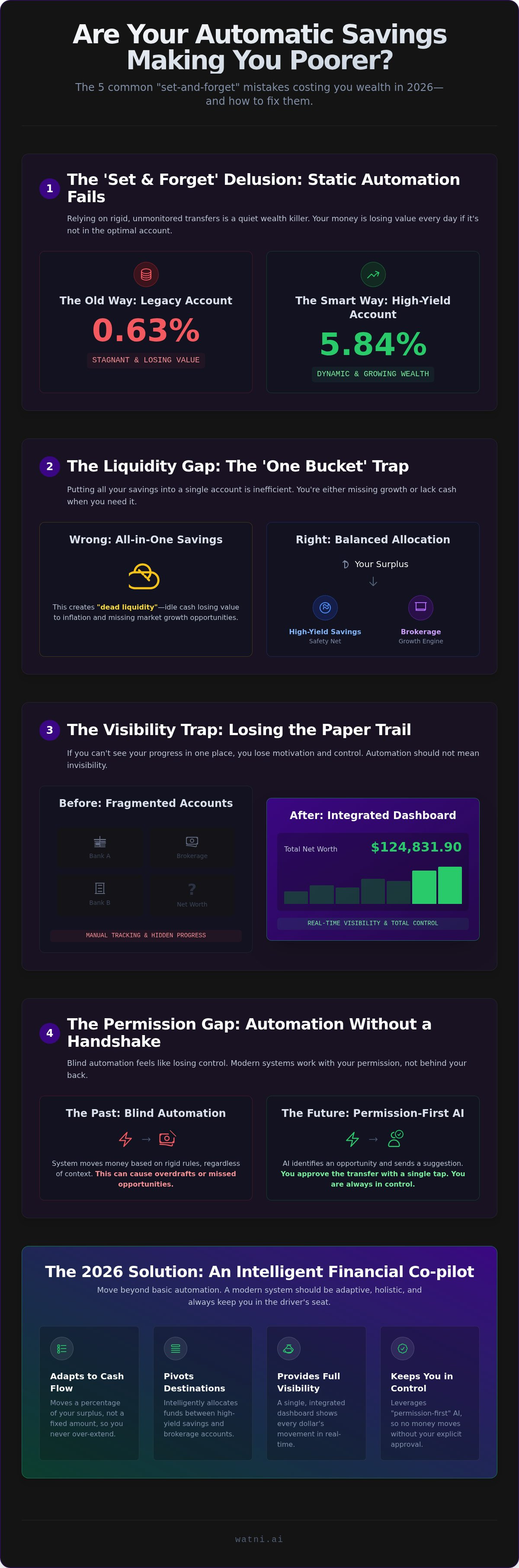
We've all been there. You set up a transfer years ago. You never looked back. Meanwhile, the market moved. High-yield rates hit 5.84% for top accounts, but your money stayed put in a legacy account earning just 0.63%. You feel the friction of accounts that don't talk to each other. It's frustrating. It's draining. And it's fixable.
This guide breaks down the five pitfalls derailing your progress. You'll learn how to stop losing money to rigid, blind systems. We'll show you how to use permission-first AI to maximize every dollar. You'll regain visibility. You'll keep your wealth on autopilot. It's time your money started listening to you again.
Key Takeaways
- Static transfers are dead. Learn why rigid automation fails in 2026 and how to keep your strategy agile.
- One bucket is a trap. We'll show you how to balance cash and growth so your money is always in the right place.
- Visibility is power. Stop making common automatic savings mistakes that hide your progress behind a digital curtain.
- Automation needs a handshake. See how permission-first AI keeps you in control while the tech does the heavy lifting.
The 'Set and Forget' Delusion: Why Static Automation Fails
"Set and forget" was a mantra for the 2010s. In 2026, it's a financial trap. Many people believe automation solves everything. It doesn't. Relying on rigid, unmonitored transfers is the foundation of most automatic savings mistakes. If your bank moves the same $400 every month regardless of your actual cash flow, the system is blind. It ignores your life. It ignores the market. And it ignores your potential for growth.
The Danger of Passive Ignorance
Forgetting your savings leads to stagnant asset allocation. It's a quiet wealth killer. If your money sits in a legacy account earning 0.63% while high-yield rates reach 5.84%, you aren't saving. You're losing value to inflation every single day. Modern personal finance principles demand more than just "putting money away." You need your assets to work as hard as you do. Passive ignorance is just a slow leak in your bucket.
Why Your System Needs a Pulse
Life isn't linear. Your spending isn't either. Fixed monthly transfers are obsolete because they don't account for reality. One month you have a surplus; the next, an emergency repair hits. You need a system that breathes with you. Intelligent automation monitors your accounts in real time. It shifts from "fixed amounts" to a "percentage-of-surplus" model. This ensures you never over-extend or miss a chance to invest. By using a personalized financial roadmap, your savings strategy becomes a living document. It adapts to your goals. The tech respects your boundaries. Most importantly, it keeps your wealth moving forward without the risk of blind automation.
The Liquidity Gap: Choosing the Wrong Destination
Most people dump every extra cent into a single savings account. It feels safe. It's also lazy. This is one of the most expensive automatic savings mistakes you can make. You're trading long-term wealth for short-term comfort. If your emergency fund is already full, every extra dollar in a standard account is "dead liquidity." It's idle cash. It's losing to the market. In 2026, with inflation still a factor, idle cash is a melting ice cube.
You need a split. You need a balance between high-yield security and brokerage growth. Sending all your automated transfers to a single, inaccessible bucket creates a liquidity gap. You either have too much cash doing nothing or too little cash when a tire blows. For a better approach, check our automated wealth building strategy. It moves beyond the "one-size-fits-all" trap.
High-Yield vs. Brokerage: The Balancing Act
Where should the next dollar go? Your system needs to know your total net worth. If your high-yield account hits its target, the automation should pivot. It should move toward your brokerage. This ensures you're capturing growth without sacrificing your safety net. It's about precision. It's about making sure your money is always in the highest-yielding spot allowed by your risk tolerance.
The Integration Failure
Fragmented accounts are "leaky" accounts. Most banks don't talk to brokerages. You end up doing the manual heavy lifting. You log in. You transfer. You wait three days for the funds to clear. This friction kills momentum. True wealth happens when your accounts are integrated. You can connect your bank and brokerage to see the full picture. When your accounts talk to each other, your money moves faster. It works harder. You stay in control without the manual headache. It's the difference between a stagnant pile of cash and a dynamic engine of growth.
The Visibility Trap: Losing the Paper Trail
Automation is great until it becomes invisible. If you don't have a single dashboard to view your movements, you're flying blind. This is a classic automatic savings mistake. You lose the paper trail. You lose the emotional connection to your progress. Psychology tells us that "hidden" money is much harder to optimize. If you can't see the growth, you won't feel the win. You won't be motivated to push further because the progress feels abstract. It's just numbers in a void.
Forget the manual spreadsheets. They're slow. They're prone to error. They're dead the moment you close the tab. In 2026, spreadsheets are the enemy of modern AI financial management platforms. You need a system that updates itself without your help. You need to see every dollar move in real time across every integrated institution you own. This isn't just about record-keeping. It's about maintaining your financial edge.
Audit Your Automation in 3 Steps
- Step 1: Map your transfers. List every recurring movement across all your banks and brokerages. You might find "zombie" transfers you forgot existed.
- Step 2: Match to targets. Ensure every dollar aligns with specific goal based financial planning targets. If a transfer doesn't have a purpose, stop it.
- Step 3: Eliminate leaks. Cut redundant or low-performing automated movements. Small automatic savings mistakes like sending money to a low-interest account add up fast.
The Role of Real-Time Dashboards
Monthly statements are relics. They tell you what happened thirty days ago. That's too late. Real-time net worth tracking prevents the "out of sight, out of mind" trap. Visibility keeps you honest. It shows you exactly how close you are to your goals every morning. Ready to stop guessing? You can start tracking your wealth in real time today. Visibility isn't just a feature. It's your greatest wealth-building tool.
The Permission Gap: Why You Feel Out of Control
People quit automation for one reason: they don't trust it. You've likely felt the dread of a transfer hitting right before a big bill. It’s a violation of your financial space. Most automatic savings mistakes happen because traditional systems are rigid. They don't care about your real-time balance. They just follow a cold, dumb script. This lack of agency makes you want to pull the plug and go back to manual work. Don't do it. Manual is a waste of your talent.
Watni acts as the bridge. We provide the efficiency of a machine with the boundaries of a human. You aren't handing over the keys to your life. You're hiring a high-speed assistant who always asks for permission before making a move. It's the ultimate rebellion against a banking industry that wants you to stay passive and uninformed.
Automation with an Approval Button
The Watni model is built on radical transparency. Our AI analyzes your integrated accounts and identifies a genuine surplus. It creates a roadmap. Then, it sends you a notification. You hit "approve," and the money moves. This permission-first approach is the new standard for 2026. It eliminates the risk of "blind" transfers that cause overdrafts or missed interest. By keeping a human in the loop, you scale your wealth with total confidence. It’s the speed of AI backed by your final word.
Taking Back the Reins
You define the rules of engagement. Want to maintain a specific buffer in your checking? Set it. Want to cap transfers at a certain amount? Done. This is intelligent financial automation that actually listens. You get the peace of mind that comes from knowing your system won't go rogue. You stop worrying about the "what ifs" and start watching your net worth climb. It's time to stop making common automatic savings mistakes and start building a system that respects your autonomy.
Your wealth shouldn't be a source of stress. It should be a source of power. Start your AI powered personal finance assistant journey with Watni today. Put your wealth on a path that you actually control.
Take Back Control of Your Wealth
Blind automation is a wealth killer. You've seen the risks of static transfers and invisible accounts. These automatic savings mistakes are easy to make but expensive to keep. You need a strategy that adapts in real time. You need visibility that actually shows you the path forward. Most of all, you need a system that respects your final word. It's time to stop letting rigid bank scripts dictate your future.
Watni is your straight-talking, tech-savvy ally. We bridge the gap with deep bank and brokerage integration and AI-powered roadmap generation. We handle the heavy lifting of finding the best yields, but you remain the pilot. Our permission-first transaction security ensures that no money moves until you say so. You get modern efficiency without the anxiety of losing control.
The era of "set and forget" is over. It's time for "approve and grow." Build your permission-first financial roadmap with Watni and start maximizing every dollar. Your wealth is waiting for you to take the lead. Let's build something better together.
Frequently Asked Questions
What is the biggest mistake people make when automating savings?
The biggest mistake is treating automation as a static event rather than a dynamic process. Most people set a fixed amount years ago and never look back. This leads to automatic savings mistakes like leaving cash in legacy accounts earning 0.63% while high-yield options offer 5.84%. You lose compounding growth because your system is blind to the market. True wealth requires a strategy that breathes with your income.
Can automatic savings cause overdraft fees?
Yes, they can. Rigid bank transfers don't care if your rent just cleared or a surprise bill hit. They execute the script regardless of your actual balance. This lack of situational awareness is why many people abandon automation entirely. To avoid this, you need a system with a buffer rule or a permission-first model. This ensures transfers only happen when you actually have a verified surplus to spare.
Is it better to automate savings to a high-yield account or a brokerage?
It is not an either-or choice. It is about the sequence. You should automate toward a high-yield account until your emergency fund is fully capitalized. Once that safety net is secure, pivot your automated surplus toward a brokerage account to capture long-term growth. A smart system monitors your total net worth and shifts the destination of every dollar based on your specific goals and current risk tolerance.
How often should I review my automated savings plan?
You should review your plan every quarter at a minimum. Any major life event like a raise, a new recurring bill, or a shift in interest rates should trigger an immediate audit. Manual reviews are tedious, which is why most people skip them. This neglect is one of the most common automatic savings mistakes. Using a real-time dashboard makes this process effortless. It keeps your strategy aligned with reality.
How does AI help avoid common savings mistakes?
AI eliminates the blind element of traditional banking. It analyzes your spending patterns, identifies genuine surpluses, and suggests the best destination for your money. Instead of a dumb script, you get an intelligent assistant that watches your back. It prevents overdrafts by checking balances first. It maximizes yield by moving funds only when it makes sense. Most importantly, it keeps you in control by asking for your explicit approval.


