
Manual budgeting is a scam designed to make you feel guilty. You know the drill. You promise to move cash to savings every month. Then life happens. A car repair here, a birthday there. You forget, you procrastinate, and your safety net stays empty. It's frustrating. You're tired of the decision fatigue and the constant fear of overdrawing your account just to save a few bucks. We get it. The old way of saving is broken because it relies on you being perfect every single day.
Building a set and forget emergency fund shouldn't feel like a second job. You can actually build a bulletproof safety net on autopilot without losing an ounce of control over your cash. With top high-yield savings rates hitting 5.84% in 2026, leaving your money in a standard account is just throwing potential earnings away. This guide breaks down the 2026 automation checklist. You'll learn how to integrate your accounts, use AI to find "lazy" cash, and set up a permission-first system that handles the heavy lifting. It's time to stop manual transfers and start trusting a system that finally works.
Key Takeaways
- Stop fighting your own willpower. Learn why manual transfers are designed to fail and how to eliminate decision fatigue for good.
- Follow our streamlined 2026 checklist to build your set and forget emergency fund using high-yield accounts that actually outpace inflation.
- Upgrade to dynamic automation. See how AI scans your cash flow to find "found money" you won't even miss.
- Turn your safety net into a launchpad. Discover how to pivot your completed fund into a personalized wealth-building engine.
Why Manual Savings Fail (And Why You Need to Automate)
Discipline is a lie. We're often told that saving requires grit and iron willpower. It doesn't. It requires a system. Manual transfers fail because they depend on your mood. If you're stressed, you don't save. If you're busy, you forget. This friction creates a massive gap between your goals and your actual bank balance. Building a set and forget emergency fund isn't about willpower; it's about architecture.
Before diving into the tech, let's be clear on the core goal. You can find a basic definition of what is an emergency fund online, but the real challenge isn't the definition. It's the execution. Every manual transfer is a choice. Do I save, or do I buy that new gadget? Your brain is tired. It chooses the instant win every time. Automation kills the choice. It makes saving the default, not the exception.
Old-school methods like spreadsheets and prayer are obsolete in 2026. We've moved past "saving what is left" at the end of the month. The psychological shift to "paying yourself first" is only possible when you remove the human element. You need a system that acts before you can overspend.
The Cost of Procrastination
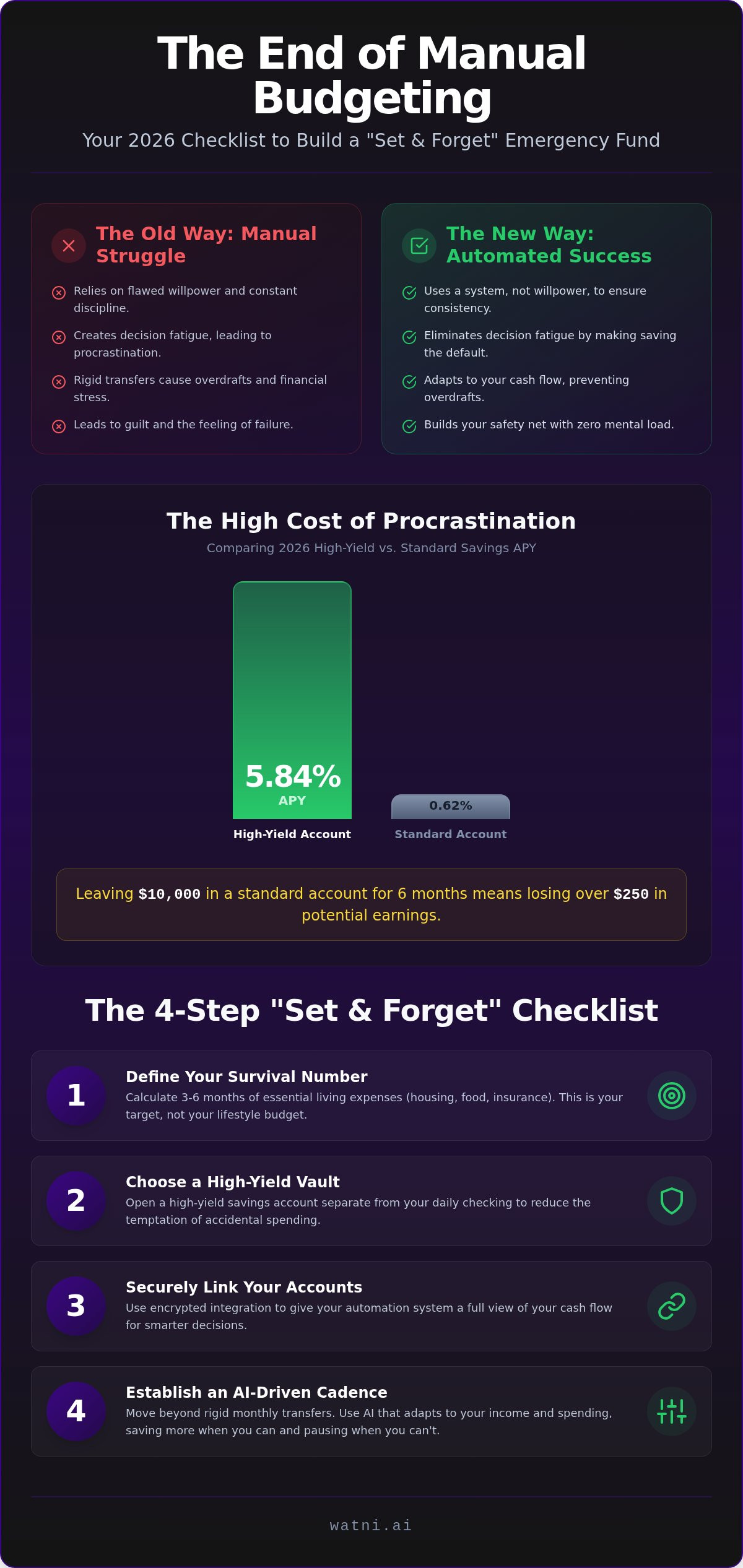
Waiting is expensive. Top high-yield accounts in 2026 offer up to 5.84% APY. If you sit on $10,000 in a standard 0.62% account for six months while "thinking about it," you're torching over $250 in potential earnings. Someday is not a financial strategy. It's a leak in your bucket that needs to be plugged immediately.
Automation as a Behavior Hack
Psychology proves it. If you don't see the money, you don't miss it. By the time you check your balance, the work is done. It's the ultimate "out of sight, out of mind" play for your liquid cash. Modern AI doesn't just move money; it finds the gaps in your spending so your set and forget emergency fund grows without you feeling the pinch.
The 2026 Set and Forget Emergency Fund Checklist
You can't automate a goal you haven't defined. Most experts suggest saving between three and six months of expenses, but your "Sleep Well at Night" number is personal. It should cover absolute essentials like housing, food, and insurance. If you're unsure how much to save in an emergency fund, start with a bare-bones survival budget. Liquidity is the priority here; your safety net must be cash that's accessible within 48 hours without penalties or market risk.
- Step 1: Define your survival number based on essential monthly costs.
- Step 2: Choose a high-yield destination that sits outside your daily spending bank.
- Step 3: Securely link your primary checking and brokerage accounts for full visibility.
- Step 4: Establish an AI-driven cadence that adapts to your actual cash flow.
Setting Your Target Number
Don't confuse your lifestyle with your safety net. Your emergency fund isn't for maintaining your streaming subscriptions or dining out. It's for survival. When you strip away the fluff, your target becomes much more achievable. Focus on the core bills first. This clarity prevents you from feeling overwhelmed by a massive, unreachable goal.
Choosing the Right Vault
Keeping your savings in your checking account is a recipe for accidental spending. It's too visible and far too tempting. In 2026, some high-yield accounts offer up to 5.84% APY, while the national average remains a pathetic 0.62%. That's a massive gap in potential earnings. Success starts with securely linking bank accounts for automatic savings so the money moves before you can touch it.
Step 3 requires a secure bridge. Link your primary checking to your high-yield vault using encrypted integration. This visibility lets your system see the whole picture. Finally, move away from rigid monthly transfers that might hit when your balance is low. A modern set and forget emergency fund uses a dynamic cadence. It shifts more when you have a surplus and pauses when things are tight. By using an automated savings engine, you build your safety net with zero mental load. It's about being smart, not just being fast.
Smart Automation: Beyond Simple Recurring Transfers
Standard bank transfers are brittle. They're "dumb" automation. You set a date, you set an amount, and you hope for the best. But life isn't static. What happens if an insurance premium hits the same day? Or if you had an expensive car repair last week? A rigid transfer doesn't care. It moves the money anyway. This leads to overdraft fees and unnecessary stress. That isn't a set and forget emergency fund. It's a financial landmine.
The AI Advantage
True automation is dynamic. In 2026, AI analyzes your actual cash flow in real-time. It identifies your unique spending patterns and spots "found money" you won't miss. Instead of a fixed $200 on the 1st, it might move $40 on a quiet Tuesday when your balance is high. It might skip a week entirely if your checking account looks thin. This intelligent monitoring ensures you're always building your safety net without ever risking an overdraft.
This is the first step toward a bigger picture. Once your fund is stable, you can easily pivot to a broader automated wealth building strategy. Your emergency fund acts as the foundation for all your future investments.
Maintaining Total Control
Automation doesn't mean losing authority. The best systems use a "Permission-First" model. You get a notification: "We found $65. Move to savings?" You tap yes or you tap no. The AI does the heavy lifting, but you hold the keys. Human-in-the-loop automation provides the speed of tech with the safety of your own judgment. It's high-tech protection without the anxiety of a black box taking your money without asking.
Ready to stop guessing? You can connect your accounts to Watni today to build a system that actually adapts to your life.
Scaling Your Safety Net into a Wealth Engine
Building a set and forget emergency fund is just the beginning. Most financial advice stops once you've saved your six months of expenses. That's a mistake. A full emergency fund isn't a finish line; it's a launchpad. In 2026, the "hands-off" millionaire isn't a myth. It's anyone who uses technology to move past survival and into growth without thinking about it. You've built the foundation. Now it's time to build the house.
The Pivot to Growth
Once you hit your target number, your system shouldn't just stop. It should pivot. This is where the "Waterfall" method comes in. Any excess cash that would have gone into your savings now flows directly into your brokerage accounts. By using your personalized financial roadmap, you can determine exactly when that shift happens. You don't have to monitor balances. You don't have to manually change your transfers. The system recognizes the bucket is full and starts filling the next one automatically.
The Watni Way
This is how you transition to an AI driven investment plan. Watni acts as the engine for this entire process. It manages the movement of every dollar based on the rules you set. You aren't losing control; you're gaining an assistant. You still get the final say on every transaction through the permission-first model. We handle the math and the execution. You handle the life you're building. It's the ultimate way to maintain a set and forget emergency fund while simultaneously funding your future.
Don't let your money sit idle. Your safety net is the foundation, but your future needs more. You can join the waitlist at watni.ai to start building your automated wealth engine today.
Stop Guessing. Start Building.
Manual savings are a relic. They rely on a version of you that never gets tired. That person doesn't exist. You've seen the checklist. Define your number. Choose your vault. Link your accounts. Ditch the rigid transfers for a system that actually understands your life. Building a set and forget emergency fund is the first step toward true financial freedom. It isn't just about a rainy day; it's about the foundation for everything else. You don't need another spreadsheet. You need a partner that handles the heavy lifting while you keep the final say.
Watni provides bank-grade security and AI-powered cash flow analysis to find the money you're currently missing. Our permission-first automation keeps you in the loop. You get modern efficiency without the anxiety of losing control. Stop worrying about "what if" and start knowing you're covered. Build your personalized financial roadmap with Watni AI today. Your future self is already thanking you.
Frequently Asked Questions
How much should I actually have in a set and forget emergency fund?
Aim for three to six months of absolute essentials. This covers housing, food, and insurance. It isn't about your total income; it's about survival. If your monthly essentials cost $3,000, your target is $9,000 to $18,000. Start with a smaller "starter" goal if that feels heavy. The key is knowing your specific number before you flip the switch and start the automation.
Is it safe to let an AI app manage my savings transfers?
It's safe when the system uses a permission-first model. Don't use "black box" apps that move money without asking. A secure AI assistant analyzes your cash flow and pings you for approval. This keeps you in the driver's seat. Look for bank-grade encryption and systems that never store your login credentials. Safety comes from transparency and control. You always have the final say.
What is the best type of account for an automated emergency fund in 2026?
A High-Yield Savings Account (HYSA) is the gold standard in 2026. Top accounts currently offer Annual Percentage Yields (APYs) up to 5.84%. Compare that to the national average of 0.62%. You want an account that is FDIC insured and separate from your daily checking. This keeps your set and forget emergency fund out of reach but still perfectly liquid when you need it.
Can I cancel an automated transfer if I have an unexpected expense?
You can always cancel or skip a transfer. Modern automation isn't a locked contract. If an unexpected bill hits, you simply decline the transfer notification. This is why the permission-first model matters. It prevents the system from moving money when you're tight on cash. You maintain total visibility and authority over every dollar. The technology works for you. It never takes control away.
How long does it take to build a full emergency fund using automation?
Timelines depend on your "found money" cash flow, but automation is always faster than manual saving. AI finds small amounts of cash you'd otherwise spend on fluff. By capturing $10 or $20 multiple times a week, you build momentum without feeling the pinch. Most users see a fully funded set and forget emergency fund months sooner because the system never forgets to save.


