
Your spreadsheet isn't just boring; it's a liability. You spend hours manual-tracking accounts only to end up with analysis paralysis and a massive headache. It's exhausting to manage every penny when you're terrified a single hallucination from a chatbot could wreck your life savings. You want growth, but you don't want to hand over the keys to a black box. We get it. Trusting an ai financial planner feels like a leap of faith when the stakes are this high.
This isn't about 2023-era chatbots that just spit out generic advice. By 2026, the reality has changed. Modern AI is a permission-first execution engine designed to automate your wealth without stripping away your autonomy. We'll show you how to connect your brokerage accounts and build a personalized roadmap that only moves when you hit approve. We are going to debunk five dangerous myths and reveal the truth about how secure, automated systems are finally replacing the manual grind. It's time to stop managing your money and start growing it.
Key Takeaways
- AI isn't a search bar. It is a digital architect for your net worth that actually executes your strategy.
- Modern tools are execution engines. Discover how an ai financial planner automates portfolio rebalancing without the manual grind.
- You keep the keys. The permission-first model ensures your money only moves after you give explicit approval.
- Data beats intuition. Learn why AI precision outperforms human advisors by processing thousands of variables in seconds.
Beyond the Hype: What an AI Personal Finance Assistant Actually Is
Forget the search bar. Most people treat AI like a high-speed encyclopedia. They ask it how a Roth IRA works or what the 2026 tax brackets look like. That's a waste of potential. A modern ai financial planner isn't a chatbot; it's a digital architect for your net worth. It is a software layer designed to analyze, plan, and execute your entire money strategy. It looks at the messy reality of your accounts and builds a structure that actually holds weight.
This isn't about manual entry or clunky spreadsheet templates. Modern systems integrate directly with your existing bank and brokerage accounts. They see the data in real time. This connectivity allows the AI to move beyond generic tips. It understands your specific cash flow, your risk tolerance, and your current holdings. The goal is simple: stop the "knowing what to do" phase and start "getting it done."
- Analyzes: It scans every transaction to find hidden efficiencies.
- Plans: It builds a roadmap based on your actual life, not a generic template.
- Executes: It prepares the moves so you don't have to.
Advice vs. Execution
Old AI told you to save more. It gave you a pat on the back and a PDF to read. New AI finds the money and sets up the transfer. This is the core of intelligent financial automation. It's the difference between a fitness app that tells you to run and a treadmill that's already moving. You don't need more advice; you need an execution engine. When the system identifies an opportunity to rebalance your portfolio, it doesn't send a vague notification. It drafts the transaction. You review it, hit approve, and the work is finished. That's how wealth is built in 2026.
The "Chatbot" Myth: Why Modern AI is an Execution Engine
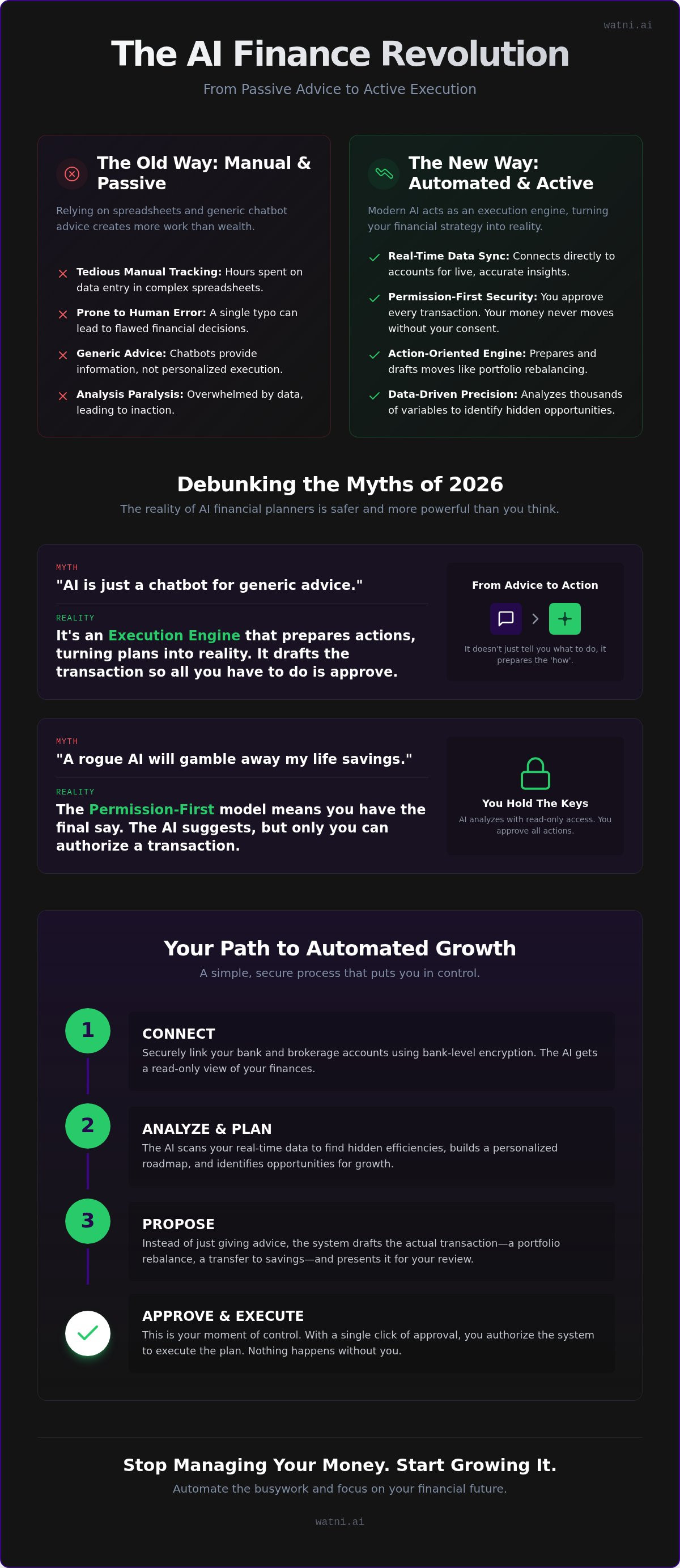
The myth is simple: AI is just a glorified search bar that gives you a to-do list you'll never finish. People think it's just for asking "How do I save for a house?" and getting a generic response. That's 2023 thinking. In 2026, a real ai financial planner is an execution engine. It doesn't just suggest you should open a high-yield savings account or rebalance your portfolio. It prepares the move for you.
And it does it accurately. Modern assistants can help open accounts, move funds between brokerages, and adjust your risk exposure based on market shifts. It replaces the static roadmap with a living, breathing strategy. It handles the boring, repetitive tasks so you can focus on the big picture. This shift turns your finances from a passive list into an active machine.
The Death of the Manual Spreadsheet
Manual tracking is the number one reason people fail their financial goals. It's tedious. It's prone to error. Most importantly, it creates spreadsheet fatigue. You spend three hours on a Sunday night inputting data only to realize you missed a transaction from three weeks ago. It's a losing game. By the time the data is in, it's already old.
Using an ai powered financial assistant eliminates these data entry errors instantly. By connecting directly to your accounts, the system pulls live data without you lifting a finger. It turns your finances from a chore into a background process.
But accuracy isn't the only win. It's about speed. While a human might take weeks to realize their asset allocation is off, an ai financial planner catches it in seconds. It drafts the fix and waits for your signal. If you're ready to stop playing data entry clerk and start building wealth, you can get started with a permission-first assistant today. It's about taking control by letting the tech handle the heavy lifting.
The "Safety" Myth: How Permission-First AI Keeps You in Control
The biggest fear is a rogue algorithm. You worry an AI will wake up, decide your risk tolerance is too low, and dump your life savings into a volatile meme coin while you sleep. It's a valid concern. But it's also a total myth. In 2026, a legitimate ai financial planner doesn't have the power to go rogue. It operates on a permission-first architecture. You are the pilot. The AI is just the highly efficient co-pilot sitting in the second seat. It suggests the route, but you're the only one with hands on the controls.
Security isn't an afterthought; it's the foundation. Modern systems use bank-level encryption and read-only access to analyze your data. This is one of the core benefits of linking all financial accounts. It allows the system to see the full picture without having the ability to move a single cent without your say-so. You get the visibility of a pro without the risk of a breach. The technology handles the heavy lifting of data processing, yet it remains fundamentally tethered to your choices.
The Permission Layer Explained
Watni doesn't just act. It proposes. Every time the system identifies an opportunity to save you money or optimize a portfolio, you get a notification. It's a simple, direct "Yes" or "No" interface. Explicit approval is the non-negotiable standard for wealth tech today. No approval? No movement. It's that simple. You maintain total autonomy while the tech handles the complex math in the background. It turns your phone into a command center for your net worth.
Don't let fear keep you stuck in manual mode. You can have automation and total control at the same time. It's about radical transparency. If you're ready to see how safe execution works, secure your wealth strategy with Watni and start building with confidence. Stop worrying about what the AI might do and start seeing what it can do for you.
The "Human-Only" Myth: Why AI is Often More Precise
The old guard wants you to believe that wealth management requires a firm handshake and a mahogany desk. They claim that only a human can understand the "subtle aspects" of your life. It's a convenient narrative for people charging high fees, but it's factually wrong. In reality, a human advisor takes weeks to build a comprehensive plan. An ai financial planner does it in seconds. It processes thousands of variables, from tax law changes to market volatility, without ever getting tired or distracted.
AI doesn't have "off days." It doesn't get bored with your small-balance accounts, and it doesn't have the unconscious biases that lead humans to play it too safe or too risky. While a human might miss a sudden shift in your spending habits, the AI catches it instantly. This level of precision creates a personalized financial roadmap that updates every time you spend a dollar. It's not a static PDF sitting in a drawer; it's a live calculation of your future. If your income drops or a surprise bill hits, the system recalibrates your strategy before you even finish your coffee.
Cost vs. Performance
The math is brutal for traditional firms. Most human advisors charge around 1% of your total assets every year. That might sound small, but over decades, it can eat up a third of your potential wealth. Modern AI costs less than your Netflix subscription. It provides the same fiduciary-grade logic once reserved for the ultra-wealthy, but without the gatekeeping or the overhead. We've moved past the era where high-level strategy was a luxury. Now, the most precise ai financial planner in the room is the one in your pocket. It’s about getting better results for a fraction of the price, which is the only metric that actually matters for your net worth.
Take Command of Your Financial Future
The era of "advice-only" tools is dead. You don't need another list of things to do; you need a system that does the work for you. A modern ai financial planner bridges the gap between seeing your goals and actually hitting them. It's about moving from manual spreadsheet fatigue to an automated, live roadmap that reacts as fast as you spend. You've seen the myths. Now you know the 2026 reality.
Safety isn't a trade-off for speed. With permission-first security, nothing moves without your explicit "yes." You get the power of real-time bank integration and zero manual data entry without ever losing the keys to your accounts. The technology handles the complexity so you can focus on the results. It's time to stop fighting with clunky templates and start building real wealth. You have the tools. You have the control. Now, take the first step toward a smarter strategy.
Stop guessing. Build your permission-first wealth roadmap with Watni.
Your future is waiting. Let's get to work.
Frequently Asked Questions
Is an AI personal finance assistant safe to use with my bank?
Yes. It uses bank-level encryption and secure, read-only access to analyze your data. It connects through established APIs so it never stores your actual login credentials. You get the same security standards used by major global banks. It's a secure bridge to your data, not a backdoor to your funds. You get full visibility without any of the vulnerability. It's safe, fast, and transparent.
Can an AI assistant move money without my permission?
Absolutely not. A legitimate ai financial planner operates on a permission-first architecture. It can draft transactions and identify savings opportunities, but nothing happens until you hit approve. You are the only one with the power to move money. Think of it as a highly efficient co-pilot. It suggests the route, but you always keep your hands on the controls. If you don't say yes, the money stays put.
How does an AI financial assistant differ from a budgeting app?
Budgeting apps just track the past. They show you charts of where your money went last month. An AI assistant executes the future. It doesn't just categorize your coffee spending; it connects to your accounts to rebalance portfolios and automate wealth building. It's an execution engine, not a digital receipt book. One looks at where you were. The other drives you toward exactly where you want to be.
Do I still need a human financial advisor if I use AI?
It depends on your needs. AI handles the math, the data processing, and the daily execution of your roadmap with extreme precision. It's often more accurate than a human for routine management. You might still want a human for complex estate planning or high-level tax strategy. AI handles the heavy lifting of wealth building. Humans handle the rare, highly complex edge cases. It's about using the best tool for the job.
What happens if the AI makes a mistake in my financial plan?
The permission-layer is your ultimate safety net. Since an ai financial planner requires your explicit approval for every transaction, you are the final checkpoint. You review every proposed move before it happens. If a suggestion doesn't look right, you simply hit reject. You get the speed of high-level automation with the total security of human oversight. The system proposes the strategy, but you provide the final authority.


