
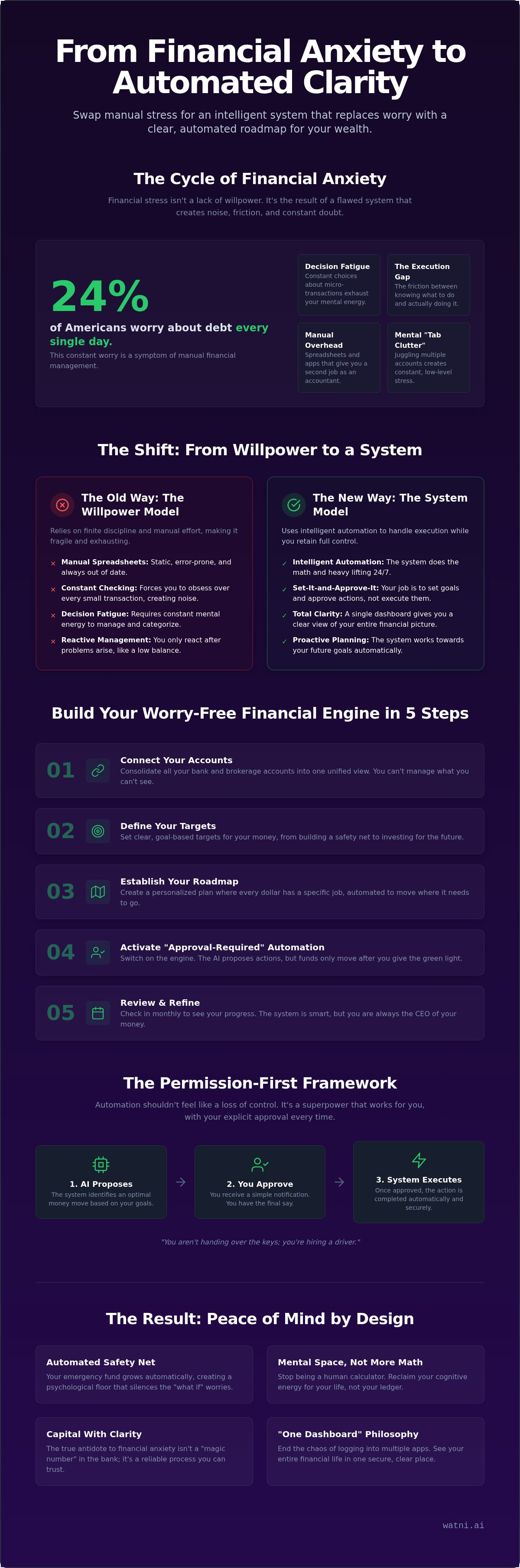
Financial anxiety isn't a math problem. It's a design flaw. You've been told that learning how to stop worrying about money requires more discipline and more spreadsheets. That's a lie. Even in 2026, 24% of Americans still worry about their debt every single day. The problem isn't your lack of willpower. It's the manual overhead trap that keeps you stuck in a loop of constant checking and second-guessing. You're exhausted by decision fatigue and the fear of an unknown future.
You deserve mental space, not more math. This guide replaces manual stress with intelligent automation. We're moving from constant anxiety to total clarity using a system-first approach. You'll learn how to build a personalized, set-it-and-approve-it roadmap that handles the heavy lifting across your accounts. It's time to stop acting like a human calculator and start using the technology you already own to secure your future. Let's build a system that finally lets you breathe and focus on life.
Key Takeaways
- Stop fighting your survival instincts. Learn how to stop worrying about money by trading manual willpower for a system that stays awake when you don't.
- Traditional budgeting is a trap. Swap exhausting spreadsheets for an automated engine that does the math while you're busy living.
- Build your roadmap in five steps. Connect your accounts and set targets to move from constant guessing to a clear, automated path.
- Trust the tech without losing control. Use a permission-first AI model that handles execution but only moves funds after you approve.
Why We Worry: The Psychology of Financial Noise
Money stress isn't about the zeros in your bank account. It's about noise. Your brain treats financial complexity like a predator in the bushes. It's a survival mechanism. When you lack a system, your mind stays on high alert. This is why "The Worrier" exists at every income level. You can have millions and still lose sleep because you lack a reliable process. If you want to learn how to stop worrying about money, you have to close the "Execution Gap." This is the exhausting friction between knowing what to do and actually doing it.
Ironically, manual tracking makes this worse. It forces you to obsess over every tiny transaction. You stare at spreadsheets until the numbers blur. This constant focus on small details keeps your nervous system in a loop of panic. It's not planning. It's rumination. You're trapped in the weeds when you should be looking at the horizon.
The Myth of the "Magic Number"
You think hitting a specific savings goal will fix the dread. It won't. Capital without clarity is just a bigger pile of assets to stress over. Peace doesn't come from a balance. It comes from a process. Clarity is the real antidote. If you want to master how to stop worrying about money, stop chasing a specific number and start building a system. When you know your future is automated, the balance matters less than the engine driving it.
Decision Fatigue in Modern Finance
Modern finance is a mess of accounts. You have three banks, two brokerages, and endless subscriptions. This creates mental "tab clutter." Every login is a micro-stressor. Every manual transfer is a chore. The cost of manual wealth management is your mental health. You're spending your limited cognitive energy on math instead of your life. That's a bad trade. You don't need more discipline. You need less to think about.
Moving from Manual Spreadsheets to Intelligent Systems
Most people rely on the "Willpower Model." You try to force yourself to track every cent. It’s exhausting. It’s also why you haven't mastered how to stop worrying about money yet. Willpower is a finite resource. When you're tired, the system breaks. The "System Model" is the only way to learn how to stop worrying about money because it removes human error from the equation. It doesn't ask for your discipline. It asks for your permission. Traditional budgeting apps fail because they give you a second job. Categorizing a grocery bill isn't a strategy. It's just more paperwork.
True progress happens when you move from watching your money to directing it. This requires intelligent financial automation. Instead of reacting to a low balance, you set the rules. The tech executes the plan. You just watch it happen.
Why Spreadsheets Are Your Enemy
Spreadsheets are static. They are fragile artifacts of the past. They tell you where your money went last month, but they can't pivot in real-time. In a fast-paced 2026 economy, a manual tracker is already obsolete by the time you close the tab. You're trying to drive forward while looking in the rearview mirror. It's time to stop acting like an accountant and start acting like a CEO.
The Permission-First Framework
Automation shouldn't feel like a loss of control. It should feel like a superpower. A permission-first system means the AI proposes a move, and you hit "Approve." You retain the power to delete or adjust any action. This transparency ends the worry cycle by removing the fear of the unknown. You aren't handing over the keys; you're hiring a driver. If you're ready to stop the manual grind, you can explore how an automated engine handles the heavy lifting for you.
5 Steps to Build a Worry-Free Financial Engine
Building a system is the only way to master how to stop worrying about money. It turns abstract fear into a concrete process. Start by connecting your bank and brokerage accounts. You can't manage what you can't see. Once consolidated, define your goal-based financial planning targets. This gives your money a destination. Next, establish a roadmap where every dollar has a specific job. Move from manual transfers to an "Approval-Required" model. Finally, set a monthly check-in to review your progress. This permission-first model ensures you stay in the driver's seat while the engine does the heavy lifting.
Automating the Safety Net First
Your emergency fund is your psychological floor. Without it, every unexpected bill is a crisis. Use automation to grow this fund before you even see your paycheck. By setting a recurring, automated target, you remove the decision to save. It just happens. This foundation creates the mental space needed to focus on growth instead of survival. It's the first real step in learning how to stop worrying about money. When your safety net is self-building, the noise in your head finally starts to quiet down.
The "One Dashboard" Philosophy
Logging into ten different portals is a recipe for anxiety. It fragments your focus and creates mental clutter. A single, real-time view of your net worth reduces friction and builds confidence. You see the big picture instantly. This "One Dashboard" approach replaces guesswork with data. It turns a chaotic pile of accounts into a streamlined wealth engine. You stop fearing the unknown because the unknown no longer exists. If you're ready to stop the manual overhead, connect your accounts and start your automated plan today.
How AI Financial Planning Ends the Worry Cycle
The mental load of math is the biggest barrier to learning how to stop worrying about money. You shouldn't have to calculate compound interest or tax brackets while you're trying to sleep. An AI financial management platform handles the heavy lifting by analyzing your data and identifying the best moves in real-time. Watni builds a personalized roadmap that evolves with your life. If you get a raise or your expenses shift, the system adjusts automatically. It's dynamic, not static.
The breakthrough is the "Permission-First" model. Unlike old-school automation that feels like a black box, Watni works as your protective ally. It proposes a strategy. You hit the button. You're the pilot; the AI is the navigation system. This balance of power is essential for building trust. It creates a state of "Quiet Wealth" where your money moves toward your goals while you focus on living. You gain the clarity needed to finally master how to stop worrying about money for good.
The Future of Wealth is Automated
2026 is the year we finally stop being our own part-time accountants. We are moving beyond "Budgeting," which is just looking at the past. We are entering the era of "Wealth Orchestration." This is about directing future cash flow with surgical precision. You don't need a spreadsheet to tell you that you spent too much on lunch. You need an engine that automatically funds your brokerage account before the bill even arrives. It's about movement, not just monitoring.
Taking the First Step
You don't have to automate your entire life on day one. Start small. Set up a single "Approval-Required" transfer to your safety net. The immediate relief of seeing a plan in motion is addictive. Once you see the system working, the anxiety starts to evaporate. You aren't just learning a theory. You're putting an engine in place that does the work for you.
Build Your Wealth Engine Today
Financial anxiety is a signal. Your system is broken. It's not a character flaw. You've seen how trading manual spreadsheets for intelligent automation creates the mental space you deserve. You've learned that true clarity comes from a consolidated view and a permission-first framework. This is how to stop worrying about money in a world that never stops moving. You don't need more discipline. You need a better engine.
Watni provides the seamless bank and brokerage sync required to see your whole picture. It delivers AI-driven personalized planning while keeping you in control with permission-first security. You approve every move. The math happens in the background. The wealth builds while you sleep. Stop acting like an accountant and start living like a CEO. Stop worrying and build your roadmap with Watni AI. Your future is waiting. Let's build it. You are in control now. The noise stops here.
Common Questions About Financial Automation
Is it safe to let AI manage my financial plan?
Yes, it's safe when the system uses a permission-first architecture. The AI doesn't have a blank check to move your money. It analyzes your data and proposes the best moves based on your goals. You maintain total control because nothing happens without your explicit approval. This layer of human oversight combined with high-level encryption ensures your assets remain secure while the technology handles the complex math.
How much money do I need to start using a financial roadmap?
You don't need a high net worth to start. A financial roadmap is about the process, not the balance. Whether you're managing your first $1,000 or a complex portfolio, the system works the same way. It's the best way to learn how to stop worrying about money because it builds the habit of automation early. You start where you are and let the system scale as your income grows.
What is permission-first AI in personal finance?
Permission-first AI is a security model where the technology acts as an advisor, not a solo operator. The AI identifies opportunities to save or invest across your accounts. It then sends you a notification with the proposed action. The funds only move once you hit "Approve." This ensures you stay in the driver's seat while the AI handles the execution and integration across your various bank and brokerage portals.
Will automating my money make me lose track of my spending?
No, it actually provides more clarity. Traditional budgeting fails because it's reactive and manual. When you automate your wealth strategy, you shift your focus from what you spent to where your money is going. You'll use a single dashboard to see your entire net worth in real-time. This high-level view helps you understand your financial health better than any manual spreadsheet or daily receipt tracking ever could.
How do I stop obsessively checking my bank account balance?
You stop checking when you trust the system. Obsessive checking is a symptom of uncertainty. By using an automated roadmap, you know exactly what every dollar is doing. When you have a plan that executes itself, the need for constant monitoring evaporates. This is the ultimate secret to how to stop worrying about money. You trade the stress of manual checking for the peace of a self-correcting wealth engine.


