
Checking your bank balance shouldn't feel like a jump scare. If your heart rate spikes every time you open a finance app, you aren't failing. You're just exhausted. Traditional financial anxiety management tells you to track every cent in a clunky spreadsheet. It's a lie. Manual tracking doesn't create control. It creates a second job you never wanted. You're stuck in a cycle of decision paralysis and guilt, waiting for a sense of security that never arrives.
It's time for a different approach. You deserve clarity without the manual grind. This article explains how to replace the stress of constant monitoring with a permission-first automation framework. You'll learn to use AI-driven planning and brokerage integration to build a system that handles the heavy lifting while you remain the ultimate gatekeeper. We'll show you how to automate your savings and investments so your future stays on track while you finally breathe easy. Stop managing your stress and start delegating it.
Key Takeaways
- Manual tracking doesn't work. Learn why spreadsheets fuel stress and how the avoidance loop keeps you stuck in a cycle of fear.
- Stop guessing. Use a modern framework for financial anxiety management to get a single, clear view of your money.
- Let AI do the math. Delegate the heavy analysis to find your safe to spend number without the mental exhaustion.
- Keep your autonomy. Discover how a permission-first model handles the work so you're always the ultimate gatekeeper.
What is Financial Anxiety? Identifying the Silent Wealth Killer
Financial anxiety isn't just about being broke. It's a chronic state of stress that hits you regardless of your net worth. You can have a healthy brokerage account and still feel like the floor is about to drop out. Effective financial anxiety management starts by recognizing this isn't a math problem. It's a nervous system problem. It's the persistent weight of uncertainty that follows you from your desk to your dinner table.
The "Avoidance-Anxiety Loop" is the real killer. You feel stressed about money, so you stop checking your accounts. Because you stop checking, the unknown becomes a monster. The fear grows in the dark. Soon, you're trapped in a cycle where the only thing scarier than your debt is your own bank app. You start experiencing specific physical markers:
- Insomnia and racing thoughts at 3 AM.
- Total decision fatigue over simple daily purchases.
- That literal stomach drop when a banking notification pops up on your phone.
By 2026, wealth management moves at light speed. Markets shift in seconds; digital assets fluctuate while you sleep. Your manual brain isn't built to process these data points alone. Trying to do it all yourself is a recipe for burnout. Financial anxiety management in the modern age requires a system that moves as fast as the world does.
The Difference Between Concern and Anxiety
Healthy concern is a signal. It tells you to pay a bill or check a rate. It leads to direct action. Anxiety is different. It leads to total paralysis. "Having enough" won't cure it. If your system is clunky, your mind will stay messy too. You need clarity, not just a higher balance. Action creates confidence; avoidance creates a cage.
The High Cost of Decision Fatigue
Every time you manually move money, you pay a mental tax. It seems small. Just one transfer; just one spreadsheet update. But these micro-decisions drain your emotional battery. You end the day exhausted because your money system demands constant manual labor. Modern life is hard enough. Your bank account shouldn't be another chore that leaves you drained.
The Manual Budgeting Trap: Why Spreadsheets Fuel Stress
"Budget harder." That's the mantra of traditional finance. It's also wrong. Most people think financial anxiety management requires more discipline and more rows in a spreadsheet. In reality, manual tracking is a trap. It turns your wealth into a source of constant homework. You aren't managing your money; you're just documenting your stress.
Spreadsheets act as a rearview mirror. They tell you where you went wrong weeks ago. You can't change a transaction from last Tuesday. Tracking every coffee or small treat creates a "Guilt Factor" that poisons your relationship with wealth. Instead of feeling empowered, you feel policed. It's time to swap the static grid for a personalized financial roadmap that actually guides your next move.
The Failure of Traditional Budgeting Apps
Most apps are just digital receipts. They notify you that you overspent after the money is gone. That's not helpful; it's just annoying. Then comes the psychological weight of categorization. Dragging transactions into labels is a mental tax you shouldn't have to pay. It's busywork that masks a lack of real strategy. It keeps you stuck in the past instead of securing your future.
Moving from Tracking to Planning
You need a system that looks forward. Stop obsessing over what's gone and start automating what's next. Offloading the math to technology preserves your mental health. It lets you focus on living instead of calculating. If you want a system that does the heavy lifting while you stay in control, explore AI-driven planning. Let the machine handle the variables while you enjoy the clarity.
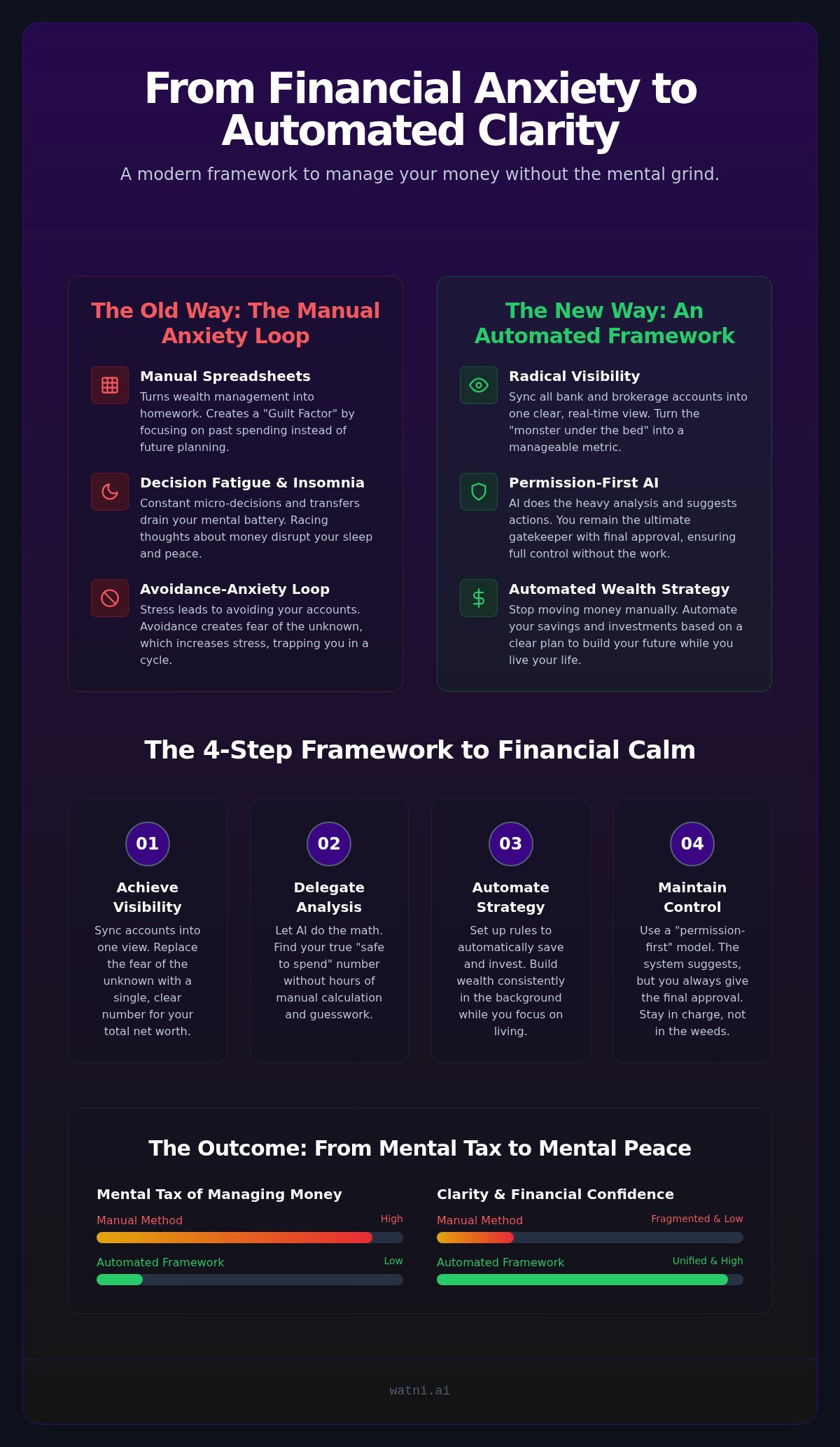
A 4-Step Framework for Financial Anxiety Management
Anxiety thrives in the dark. If your money is scattered across five different apps, you're guessing. Guessing leads to stress. Effective financial anxiety management requires a structure that replaces fear with data. You don't need more willpower; you need a better workflow. This four-step framework moves you from panic to precision in your financial anxiety management journey.
Step 1: Achieving Radical Visibility
Sync your bank and brokerage accounts into one view. Stop checking balances in isolation. Seeing your total net worth in real-time eliminates the "fear of the unknown." It's hard to be scared of a number you can see clearly. Radical visibility turns the "monster under the bed" into a manageable metric. It provides the grounding you need to make calm decisions.
Step 2: Delegate the Analysis. Next, stop doing the math yourself. Use AI to calculate your "safe to spend" number. You don't need a spreadsheet; you need an answer. When technology handles the variables, your brain can finally rest. You get the clarity of a professional audit without the hours of manual labor.
Step 3: Building an Automated Wealth Strategy
Overthinking kills progress. An automated wealth building strategy is the ultimate anxiety pill. Move your savings and investments before you have the chance to talk yourself out of it. Set "guardrails" instead of restrictive rules. This allows for flexibility without the guilt. It's about building momentum while you sleep.
Step 4: Establish a Permission-First Workflow. This is the final piece. The AI proposes the move; you hit approve. You stay the gatekeeper without doing the manual labor. It maintains your autonomy while offloading the effort. If you're ready to stop the cycle of money stress, sync your accounts and start your automated plan now.
Permission-First AI: Managing Money Without Losing Sleep
Automation used to feel cold. It felt like handing your keys to a ghost. But 2026 demands a smarter middle ground. You need a system that does the work without taking your power. This is where goal based financial planning changes the game. It isn't just about math. It's about psychology. Implementing a modern approach to financial anxiety management means trusting the tech but owning the decision.
Watni bridges the gap. It's not a scary, black-box algorithm. It's not a spreadsheet you'll ignore. It's an AI assistant that understands your roadmap. It handles the integration between your bank and brokerage accounts. Then, it waits for you. This is the new standard for financial anxiety management. Wealth management should feel like a quick conversation, not a chore. It's about delegating the complexity while retaining the authority. You don't need a human advisor to micromanage your transfers. You need a partner that handles the heavy lifting while you live your life.
Why Permission Matters for Mental Health
Control is the antidote to anxiety. When an AI moves money without asking, you feel uneasy. When you do it all manually, you feel drained. The "Permission-First" model hits the sweet spot. Watni finds the optimization, but you hit the "Approve" button. This simple act provides a dopamine hit of control without the labor. It reduces the friction of moving funds between accounts while keeping you in the driver's seat. You stay the ultimate gatekeeper of your wealth. It's the difference between being a passenger and being the captain with a world-class navigator.
Your AI Sidekick: Watni in Action
Watni builds your roadmap while you sleep. It scans your accounts, calculates your safe-to-spend number, and identifies investment gaps. But nothing moves until you say so. This direct brokerage integration ensures your money is always working toward your specific goals. You get the security of knowing exactly where every dollar goes without the mental tax of calculating it yourself. It's radical simplicity at its finest. Stop losing sleep over complex transfers. Start approving your way to peace of mind. Your future is automated. Your control is absolute.
Take Back Your Mental Space
You've spent enough time fighting clunky spreadsheets and feeling that familiar stomach drop. Modern financial anxiety management isn't about doing more work; it's about delegating the complexity. You now have the framework to move from manual chaos to automated clarity. By centralizing your view and offloading the math, you stop being a bookkeeper and start being a strategist. It's time to replace the "Avoidance-Anxiety Loop" with a system that actually looks forward.
Watni handles the heavy lifting while you stay in control. With real-time bank and brokerage sync and a permission-first safety model, you get no-nonsense AI planning that waits for your signal. No more guessing. No more guilt. Just a clear path to your goals. You're ready to stop managing your stress and start managing your wealth. It's your money and your future. Take the first step toward a quieter mind today. Build your personalized financial roadmap with Watni and finally breathe easy.
Frequently Asked Questions
Is financial anxiety a real clinical condition?
While not always a standalone DSM-5 diagnosis, financial anxiety is a recognized psychological state of chronic stress. It triggers physical symptoms like insomnia and elevated cortisol. It's more than just a bad mood. It's a persistent fear that clouds your judgment and drains your energy. Acknowledging its impact is the first step toward effective financial anxiety management. You aren't weak; your current system is just broken.
How can AI help with money-related stress?
AI eliminates the manual grind that leads to burnout. It processes data from your bank and brokerage accounts in seconds. You get the clarity of a professional audit without the hours of spreadsheet labor. Instead of guessing your budget, you receive a precise "safe to spend" number. It shifts the burden of complexity onto the machine. You get the answers you need without the mental exhaustion.
Does automating my savings mean I lose control of my money?
No. You actually gain more control by using a permission-first model. Traditional automation is a "black box" that can cause more stress. A modern AI assistant proposes moves based on your personalized plan, but nothing happens until you hit approve. You stay the gatekeeper. You get the efficiency of a machine with the final say of a human. It's the best of both worlds.
What is the fastest way to reduce financial anxiety today?
Gain radical visibility immediately. Stop jumping between five different banking apps and sync your accounts into one dashboard. Seeing your total net worth in real-time kills the fear of the unknown. Once the numbers are in the light, the panic starts to fade. Visibility is the core of financial anxiety management. It turns a vague threat into a concrete, manageable metric you can actually handle.
Can I trust an app to manage my financial planning?
Trust is built on transparency and permission. You shouldn't hand over your keys to an app that moves money in the dark. A reliable system integrates with your brokerage accounts and uses AI to build a roadmap you can see. The AI suggests the path; you authorize the movement. It's about using a smart sidekick to handle the math while you keep the ultimate authority.


